







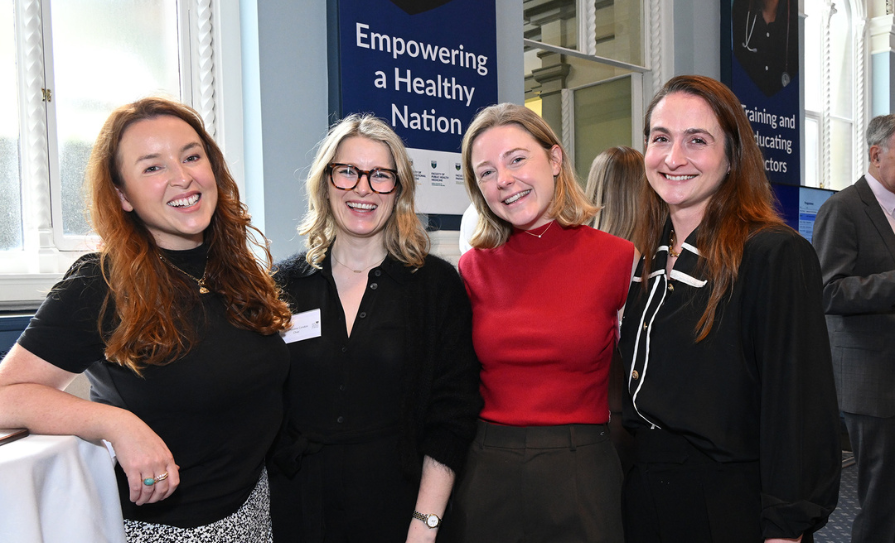
The recent RCPI meeting heard from different generations of physicians and highlighted award-winning trainee research
The RCPI’s National Education Day, which took place on 22 May, highlighted the intellectual curiosity, energy, and ambition of emerging physicians.
The meeting, which is organised by the College’s trainee committee, also explored the latest medical research and advancements in clinical practice shaping the future of healthcare.
From oral presentations tackling complex clinical questions to poster sessions highlighting practical improvements, the standard of work reflected both the depth of trainee expertise and their commitment to advancing patient care and outcomes.
“I’m encouraged by the time you put into audit and research,” said RCPI President Dr Diarmuid O’Shea at the event.
Prof O’Shea noted the important role trainees play in driving continuous improvement in clinical practice and patient care. He highlighted the value of this work not only in strengthening individual training, but in contributing to a broader culture of inquiry and evidence-based medicine across the health service.
Bringing together perspectives from across training pathways, the meeting highlighted how physicians at different career stages are responding to a rapidly evolving healthcare landscape. This key event in the RCPI calendar aims to reinforce a culture of inquiry and collaboration in healthcare.
Speakers
Speakers on the day included: Dr Sarah Murphy, Higher Specialist Trainee (HST) in Obstetrics and Gynaecology, Cork University Maternity Hospital; Dr Aoibhinn Walsh, Consultant Paediatrician, Inclusion Health Service, Children’s Health Ireland; and Prof Garry Courtney, Consultant Gastroenterologist, St Luke’s Hospital, Kilkenny.
During the Covid-19 pandemic, Dr Murphy said she witnessed a large number of pregnant patients declining the Covid vaccine because of misinformation they had read on social media. She decided to start an Instagram page to share health guidelines and updates. The page has since become a popular social media platform with 85,000 followers.
Dr Murphy discussed research proving that misinformation was having an impact on uptake of the human papillomavirus vaccine. She also highlighted that ‘patient influencers’ sharing their experience with large followings are on the rise and how ‘medical influencers’ can be a force for good.
“As we progress into the 21st Century, I think we need to acknowledge misinformation is going to increase,” Dr Murphy said. “We need to meet patients where they are.”
In her presentation, Dr Walsh shared her experience of spending three years setting up a new service – the Lynn Clinic in north inner-city Dublin for children at risk of social exclusion – while raising a family.
“It can be very challenging,” she told attendees. Dr Walsh spoke of the vital support she receives from her colleagues in paediatrics. “Find your tribe and support each other,” Dr Walsh said. “Make time for those friendships.”
Prof Courtney offered insights from his career spanning 50 years. He studied medicine at Trinity College Dublin in the 1970s and gained exposure to the specialty of gastroenterology while working in Sir Patrick Dun’s Hospital in the early 1980s.
“Because it was a small number of trainees, you had intimate mentoring,” he said.
Prof Courtney worked in St Thomas’s Hospital, London, before returning to Ireland. In the mid-1990s he accepted a job at St Luke’s Hospital, Kilkenny, which would be his base for 30 years.
It was a dramatic change from the well-equipped St Thomas’s Hospital, which he described as representing “the pinnacle of the NHS at the time”.
Soon after arriving, Prof Courtney was elected to the South-Eastern Health Board and became a strong advocate for service development, securing resources for a range of initiatives, including the establishment of a new endoscopy service.
He became involved in hospital management as Clinical Director of St Luke’s Hospital. During his time at the hospital, patient admissions increased substantially, alongside a major expansion of both consultant and non-consultant hospital doctor staffing levels.
In terms of advice he would offer to others seeking to improve services, Prof Courtney emphasised the importance of gathering robust data to support decision-making and drive change. He also underlined the value of regulation.
“Welcome inspections by the Health Information and Quality Authority and RCPI,” he said. “Regulators are your friends. Compare and contrast inequity in staffing, funding, and risk. Make business cases and put consultants on committees.”
Following Prof Courtney’s presentation, an inter-generational quiz pitted three teams of physicians against each other (The Veterans, Gen X, and The Millennials) in situations that drew on references specific to their generation. The quiz was designed to highlight how being a physician has changed over time.
Trainee awards
Each year at the National Education Day, the trainee awards recognise trainee achievements in communication, improvements in patient care and specialist education and training, and research. Winners are selected by a judging panel of clinicians.
The Corrigan Award is named after past RCPI President Sir Dominic Corrigan (1859–1863) and recognises the best Basic Specialist Trainee (BST) case study in competition. It recognises excellence in communication – the ability to identify complicated and challenging aspects of patient histories and communicate what can be learned from them.
The Award Medal was presented to Dr Andleeb Badar, BST in General Paediatrics, Coombe Hospital, Dublin, who discussed a case where a 14-year-old patient was hypocalcaemic after a general practitioner prescription of the penicillin antibiotic flucloxacillin. This was suspected to be symptomatic of the rare endocrine disorder Pseudohypoparathyroidism type 1B. The diagnosis was confirmed after genetic testing.
The Arthur Eakins Award is named after Occupational Medicine Physician Arthur Eakins (1932–2022) and was introduced in 2024 by the RCPI trainee health and wellbeing subcommittee. It is awarded for a research project or quality improvement initiative which improves and promotes trainee health and wellbeing.
The Medal was awarded to Dr Kate McCarthy, HST in Geriatric Medicine, Mercy University Hospital, Cork, who presented on a project designed to highlight the impact of parenthood on medical training, and to identify challenges.
A survey circulated to trainees who are parents found 98 per cent of respondents said the rotational nature of training adds to challenges. According to the findings, 64 per cent of respondents said they had to live away from their children during training, while 79 per cent reported an impact on their work attendance.
The survey found that almost half of respondents would consider retaining childcare placements when rotating between training posts. It also highlighted challenges for breastfeeding trainees. While the vast majority of respondents had a child who was breastfed (93 per cent), only a small minority were able to access protected breastfeeding breaks (7 per cent).
The William Stokes Award recognises research of the highest standards carried out by those in HST positions or on the International Clinical Fellowship Programme.
The Medal was awarded to Dr Joanne Byrne, HST in Infectious Diseases, St Vincent’s University Hospital, Dublin, who discussed an immunoassay her team developed to measure the effectiveness of the vaccine administered during the 2022 Mpox outbreak. The vaccine was rolled out in an emergency context, so reporting is ongoing. Dr Byrne’s immunoassay is currently implemented in three clinical trials in Europe and Africa.
The Dorothy Stopford Price Medal, honouring the pioneer in infectious disease control in Ireland who lived between 1890 and 1954, was introduced in 2018. The Medal recognises excellence in research or audit on vaccination, immunisation or control of infectious diseases, and its potential impact on public health.
The Medal was awarded to Dr Paul Reidy, HST in Infectious Diseases, University Hospital Galway. Dr Reidy received the prize for a project that geolocated patient samples at St James’s Hospital, Dublin, which tested positive for antimicrobial resistance (AMR), and examined them alongside the Pobal Deprivation Index to investigate whether socio-economic factors are associated with AMR.
Looking at a five-year patient cohort, and 6,722 laboratory-confirmed samples, Dr Reidy found that AMR patients show a modestly lower area-level score on the Index and that medical card status is strongly associated with AMR.
This article was produced by the RCPI.
To find out more about the RCPI training committee, visit: www.rcpi.ie/Learn-and-Develop/Training-Programmes/Trainee-Representation-and-Opportunities/RCPI-Trainee-Awards





Leave a Reply
You must be logged in to post a comment.