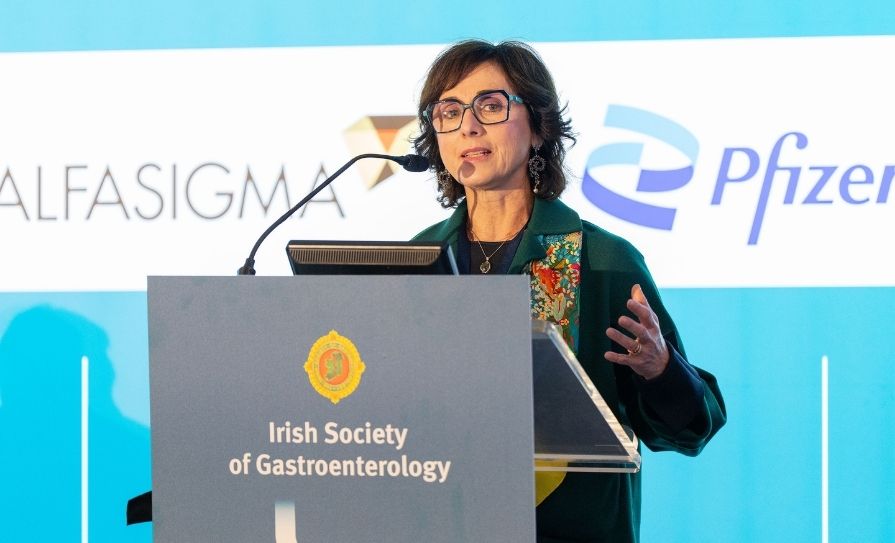
Prof Marietta Iacucci
Artificial intelligence (AI) is poised to transform the clinical care of inflammatory bowel disease (IBD) by unlocking the causes behind individual disease and enabling truly personalised medical approaches, the 2025 Irish Society of Gastroenterology Winter Meeting heard.
An internationally recognised leading researcher in the area, Prof Marietta Iacucci, Professor of Gastroenterology, University College Cork, spoke about the groundbreaking potential of AI in relation to IBD care. AI applications in IBD include optimising diagnostic imaging applications, predicting response to therapy, disease activity-scoring of endoscopy, more nuanced disease stratification, and drug discovery.
IBD is marked by significant clinical heterogeneity, posing challenges for accurate diagnosis and personalised treatment strategies. Conventional approaches, such as endoscopy and histology, often fail to adequately and accurately predict medium- and long-term outcomes, leading to suboptimal patient management, she noted.
As a complex disease with entangled relationships between genomics, metabolomics, microbiome, and the environment, IBD stands to benefit greatly from the use of AI-driven technologies that can handle this complexity, Prof Iacucci explained.
AI-driven approaches, such as the endo-histo-omics framework, which integrates endoscopic, histologic, and molecular data, offer unprecedented opportunities for precise patient characterisation and proactive personalised care, she said. AI-driven intestinal barrier healing assessment provides novel insights into deep healing, facilitating the discovery of novel therapeutic targets.
As a result, AI is now emerging as a transformative force enabling standardised, accurate, and timely disease assessment and outcome prediction, including therapeutic response, Prof Iacucci said.
As evidence, she cited a number of recent studies showcasing positive results for various AI-driven IBD tools.
These advances promise to enhance outcomes while reducing healthcare costs through more targeted therapies and minimising the use of ineffective treatments. In addition, work is now looking at the potential of AI to actually unlock the root causes of and contributors to individual IBD, which would be ‘game-changing’.
Despite challenges in its adoption, equality of access, and regulation/oversight, AI represents “a paradigm shift” in IBD care with the potential to refine risk stratification, improve therapeutic precision, and enable personalised interventions, ultimately advancing the implementation of precision medicine in routine clinical practice, she concluded.












Leave a Reply
You must be logged in to post a comment.