







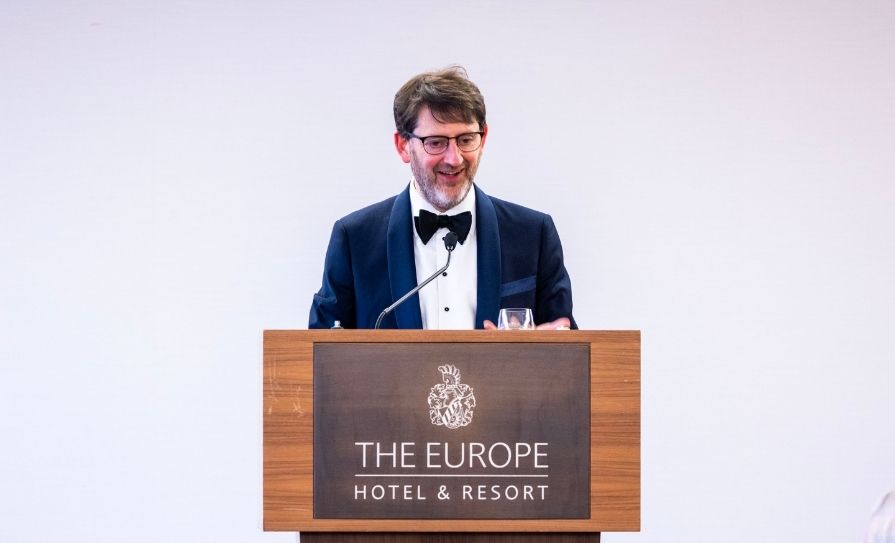
Incoming IMO President and outgoing Chair of the consultant committee, Prof Matthew Sadlier, outlines what meaningful reform of the health service would require
“Trying so, so hard, to act just like a grown up,
And it’s so, so hard,
and we’re hoping that we don’t get shown up.”
PULP, Grown Ups (More)
It is hard to fully describe the importance of Jarvis Cocker to my youthful self. At a critical moment of development, to see someone on the TV from a similarly dilapidating, unfashionable, cold, damp suburb in north-western Europe as myself – someone who unashamedly wore suit jackets, talked about books with long words, and projected arrogance toward those who didn’t – was transformative. To have one’s identity so forcibly reinforced not only gave oneself a tribe, but allowed others to place you in a now acceptable box.
2025 was the year I passed the threshold of having lived longer in the 21st Century than in the 20th. This would be fine, except I preferred the 20th.
To face that angst of this new era without a guide would have been almost impossible. But then, walking out of a mid-range department store with a copy of last year’s amazing album More in my hand, there he was again: Jarvis, with a collection of songs about how the 1990s graduate might survive in a world where Gorillaz outsell Blur.
If that psychological maelstrom was not enough to cope with, in healthcare, 2025 also sparked new old arguments about beds, waiting times, and productivity. A generation ago, when I started in medical politics, the blame for almost all of our hospitals’ ills was put down to the persistence of private practice on public hospital sites and that consultants were allowed to engage in mixed practice. We heard that if this could only be stopped then everything else would fit into place and the system would work with an efficiency that even Michael O’Leary would envy.
What of course that idea didn’t embrace was that private patients are not a political tool, but rather sick people who require medical treatment. So, what happened is largely what almost anyone could have predicted: Those that previously were treated as semi-private patients within the public system continued to attend the public hospital system. But this time the hospital got less money to treat them.
Extended hours
What of course we are now hearing is the new version of the same argument of “extended working hours”. The theory that if only consultants worked weekends, we would have a more efficient hospital system and there would be empty beds everywhere. However, what this misses is that hospitals (including their consultant workforce) already work on a 24-hour, seven-day-a-week basis providing urgent care. An army of doctors attend overnight and at weekends providing care to those who cannot wait. What does not happen at this time is the elective scheduled care, along with the logistics planning, education, and other activities that take up a consultant’s time.
Reform
Although extending working hours would seem like a sensible way of getting more work done, in reality, it is like sending factory workers into a factory without the assembly line running. The IMO is not opposed to extended services for patients. However, for a hospital to truly be more efficient for a longer day, a whole-of-hospital solution is required, which means all departments running simultaneously. For that to happen properly, you need significant redundancy in your system. By this I mean extra operating theatres so that ongoing maintenance and cleaning can occur during the day on a rolling basis without disturbing activity. It also means maintaining a high throughput of patients from the emergency department (ED) so that scanners and staff are not left idle and operating inefficiently. It also means having hospitals with all the specialties, so we don’t have a system where a doctor is tied up for an hour writing transfer letters and arranging investigations because a patient walked into an ED thinking that the hospital could treat what was wrong with them.
You would think in the absence of such facilities, there would be an efficient system to compensate for this, but that would require creative imagination. If a patient attends an ED needing care or admission in a specialty that is not available in their facility, we have no more efficient way of acquiring a bed than the on-call doctors wasting precious clinical time phoning up nearby units to get verbal confirmation on bed availability and then waiting on that service to ‘accept’ the patient.
In the absence of guidelines, one unit may request additional tests for an admission that the other hospital would not require. In a more efficient system, these tasks would be handled by a non-clinical patient flow manager, allowing the medical team to move on to the next patient, thereby reducing ED waiting times.
In 2026, with the exception of very isolated geographic areas, there is no excuse for having an acute hospital that does not have 24-hour cardiac catheterisation, stroke revascularisation, CT/MRI imaging, and endoscopy available. For this to happen, hospitals need to be at a scale that can deliver these interventions. However, at present, they are only provided by a few select facilities.
Radical reorganisation
The problem with changing the current landscape is that it requires not the superficial or incremental change, so loved by our political class, but a radical reorganisation of the health service similar to Aneurin Bevan’s introduction of the NHS across the water. In my career, there has only been one report that looked comprehensively at the structure of our hospital network – the infamous ‘Hanly Report’. It proposed a “radical reorganisation of acute hospital services”; however, what we got was political cowardice, interference, and inaction. This lack of creative imagination led to the meaningless shambolic concept of Sláintecare, which still blights us to this day.
The problem with changing the current landscape is that it requires not the superficial or incremental change, so loved by our political class
As you can see, there are many problems to solve and working for a few extra hours at the weekend is not the primary one. Despite the contradictions, oxymorons, anachronisms, and paradoxes of dealing with this, I will miss it, as I step into the role of President of the IMO.
While moving to the presidency is a new beginning (albeit one that I’ve begun previously), it also marks the end of my time as consultant Chair. I write this in advance of the election for the committee Chair for 2026/27. But looking at the names of those who are on the committee, I am assured that the interests of consultants will be well represented, both now and into the future.
Maybe I will have more time to sink into Jarvis’ comforting stories of suburban banality. As he says himself: “When you can’t even define what it is that you’re frightened of, This song will be here.” (PULP, The Fear, This is Hardcore). Thank God, someone will be.








Leave a Reply
You must be logged in to post a comment.