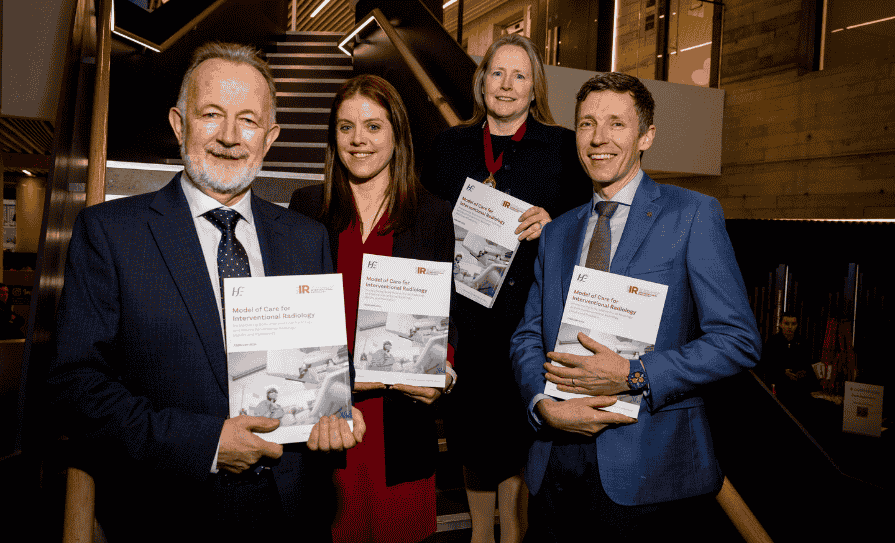
Pictured at the launch of the Model of Care for Interventional Radiology are (L-to-R): Prof Michael Lee; Ms Sara Kavanagh, Programme Manager, National Clinical Programme for Interventional Radiology; Prof Deborah McNamara, RCSI President; and Prof Colin Cantwell, Lead Author of the model of care and Vice-Dean, Faculty of Radiologists and Radiation Oncologists
The publication of the Model of Care for Interventional Radiology is not an endpoint, but a starting point for the specialty
Interventional radiology (IR) is a clinical specialty that uses minimally invasive, image-guided techniques to treat a wide range of acute and chronic conditions, often in patients who are acutely unwell or for whom surgery carries significant risk. From emergency stroke thrombectomy, control of life-threatening haemorrhage and source control in acute sepsis to elective treatments for uterine fibroids, varicocoele, certain cancers, and venous access for chemotherapy and dialysis, IR has become an integral part of day-to-day patient care.
Yet, despite its benefits for patients, access to IR services in Ireland has developed haphazardly, often depending on a local champion. Until now, services have largely evolved locally rather than as part of a coordinated national strategy. The publication of Ireland’s first national Model of Care for Interventional Radiology, by the RCSI and HSE National Clinical Programme for the specialty, marks a significant step towards addressing this gap. The model sets out a clear, clinically-led national roadmap for equitable, sustainable, and high-quality services across the country.
Interventional radiology as a modern clinical specialty
IR is no longer an adjunct to diagnostic imaging. While its roots lie in radiology, IR has evolved into a primarily therapeutic specialty, combining advanced imaging expertise with procedural skill and patient care. Procedures are typically performed through two- to three-millimetre incisions, guided by fluoroscopy, ultrasound or CT, and often under local anaesthesia or conscious sedation.
The scope of practice includes body IR, neurointerventional radiology, and paediatric IR, across both emergency and elective care. Interventional radiologists work closely with colleagues in emergency medicine, surgery, obstetrics, oncology, neurology, intensive care, and primary care.
They are increasingly responsible for the full spectrum of patient care, from outpatient consultation to peri-procedural care, follow-up, and complication management.
For patients, the benefits are clear: Low complication rates, shorter hospital stays, faster recovery and, in many cases, access to treatments that are organ-preserving or lifesaving. For the Irish health system, IR offers more efficient use of hospital resources, because most procedures do not require general anaesthetic, and are ideally suited to ambulatory care.
The case for a national model of care
Demand for IR services in Ireland is rising steadily. This demand is driven by population growth, ageing, expanding indications and advances in technology. Over recent years, there has been a marked increase in complex IR procedures, out-of-hours emergency interventions, as well as in paediatric and neurointerventional activity.
Despite these increases, a comprehensive national assessment undertaken by the National Clinical Programme for Interventional Radiology identified significant variation in service provision across the country. While all model 4 hospitals provide some level of IR service during core working hours, only a small number currently deliver a formal 24/7 IR emergency service. As a result, patient access to time-critical interventions such as embolisation for acute life-threatening haemorrhage, source control for sepsis, and other emergency conditions depends heavily on geographic location.
Paediatric IR has been particularly under-resourced, with limited formal service structures and no consistent in- or out-of-hours provision, despite clear clinical need. Workforce challenges, including shortages of trained interventional radiologists, nurses, and radiographers, further threaten service sustainability.
Importantly, these gaps are not a reflection of clinical standards or commitment, but of a system that has not kept pace with the evolution of the specialty. The model of care responds directly to this new reality.
A coordinated and networked vision
The model sets out a 10-year national framework for the delivery of services, aligned with Sláintecare, the new HSE health regions, and multiple national clinical strategies, including trauma, stroke, cancer and maternity care.
At its core is a hub-and-spoke model, with model 4 hospitals acting as regional hubs for 24/7 IR emergency services, supported by formal referral and transfer pathways from model 3 hospitals and maternity units. This approach mirrors best international practice, ensuring that patients requiring urgent intervention can access specialist expertise quickly, while maintaining appropriate levels of in-hours IR activity closer to home.
Elective care is equally emphasised. The model of care supports the expansion of outpatient IR clinics, direct referral pathways from GPs and community services, and increased use of ambulatory and day-case IR facilities.
Crucially, the framework encompasses body IR, neurointerventional radiology and paediatric IR, recognising the distinct service models required for each while ensuring national consistency in governance, quality, and access.
What this means for patients and clinicians
For patients, the benefit is significant. Consistent access to emergency IR can be the difference between life and death in conditions such as acute life-threatening gastrointestinal haemorrhage and major bleeding associated with trauma or postpartum haemorrhage. In stroke care, timely endovascular thrombectomy is one of the most effective treatments in modern medicine for selected patients, with the potential to dramatically reduce long-term disability.
For elective patients, improved access to IR offers minimally invasive procedures. Procedures such as uterine artery embolisation for fibroids, tumour ablation, or venous interventions can significantly reduce recovery time and hospital utilisation, while delivering outcomes comparable or better than traditional approaches.
For referring clinicians, a nationally coordinated IR service means clearer pathways, more predictable access and improved integration into multidisciplinary decision-making. The model of care explicitly supports consultant-led IR inpatient consultation services, IR outpatient clinics, and shared clinical responsibility where appropriate.
Workforce, training, and multidisciplinary teams
Delivering this vision depends on investment in people as much as infrastructure. IR services rely on highly skilled multidisciplinary teams, including interventional radiologists, specialist nurses, radiographers, healthcare assistants, and anaesthesiology support.
The model of care provides a detailed workforce planning framework extending to 2040, addressing current shortages and future demand. It supports expansion of training pathways, increased trainee intake, and recognition of clinical practice as a core part of new IR consultant job plans.
Parallel workforce planning for nursing and radiography is a critical component, ensuring services are safe, sustainable, and capable of delivering both in-hours and out-of-hours care.
Governance, quality, and innovation
Robust clinical governance underpins the model of care. Recommendations include the establishment of national and regional IR leadership roles, standardised data collection, audit and quality improvement processes, and the development of a national IR registry to support benchmarking and outcomes monitoring.
Technology and innovation are also central to future service delivery, with digital systems, structured reporting, and emerging applications of artificial intelligence expected to enhance safety, efficiency, and clinical decision-making.
From framework to implementation
The publication of the model of care is not an endpoint, but a starting point. Implementation will be led by the National Clinical Programme for Interventional Radiology in partnership with the HSE, health regions, and clinical stakeholders. While some recommendations will require phased investment and workforce expansion, others, including improved pathways, governance structures, and service integration, can be progressed immediately.
For clinicians across the health system, the model of care represents a clear statement that IR is no longer a peripheral service, but a core component of modern, patient-centred healthcare.
By providing a nationally agreed framework for equitable access, high-quality care, and sustainable service delivery, Ireland’s first Model of Care for Interventional Radiology has the potential to deliver tangible benefits for patients, clinicians and the health system for years to come.











Leave a Reply
You must be logged in to post a comment.