







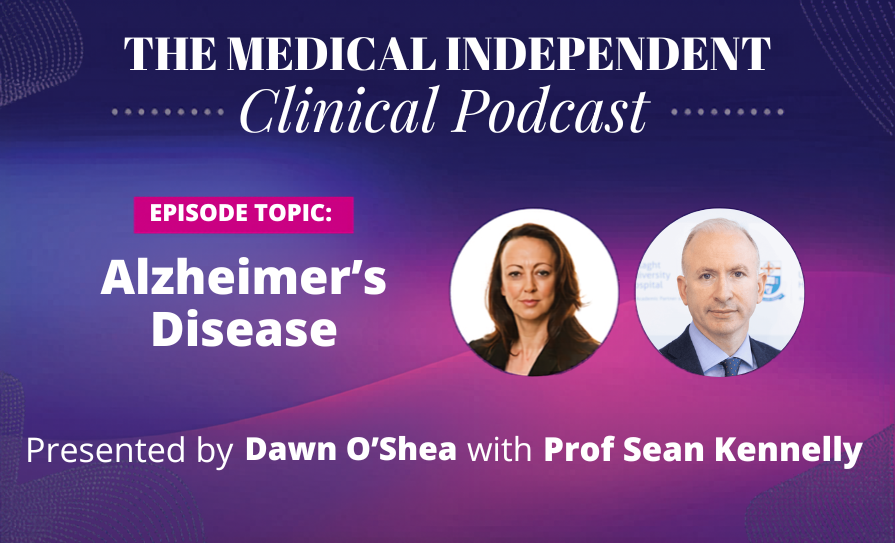
Welcome to The Medical Independent Clinical Podcast Series, where we chat to experts to empower healthcare professionals with the most up-to-date guidance on the diagnosis, prevention, and management of common conditions.
In this episode, host Dawn O’Shea is joined by Prof Sean Kennelly, Consultant Physician in Geriatric Medicine and Director of the Cognitive Clinical Trials Unit and Memory Service at Tallaght University Hospital, to take an in-depth look at dementia — its many forms, evolving diagnosis, and a rapidly changing treatment landscape.
Prof Kennelly explores the most common dementia subtypes encountered in Ireland, the practical approach to diagnosis, the role of emerging biomarkers and digital health tools, and how clinicians should approach the management of both cognitive and behavioural symptoms. The discussion also addresses the arrival of disease-modifying therapies and what the future holds for Alzheimer’s disease care in Ireland.
5 Interesting Takeaways:
- Dementia Is a Syndrome, Not a Diagnosis: Dementia describes a loss of function due to cognitive decline — it is not a diagnosis in itself. Alzheimer’s disease is the most common cause, accounting for around 70% of dementia over 65, but there are over 200 subtypes, including Lewy body dementia, vascular dementia, and frontotemporal dementia, each with distinct presentations, causative proteins, and management approaches.
- Young Onset Dementia Is More Common Than Many Realise: At least 10% of dementia cases occur in people under the age of 65, equating to approximately 6,000 people in Ireland. Younger patients are often undiagnosed for longer, as conditions such as stress or menopause are investigated first and neurodegenerative disease is not initially considered.
- Blood Tests and Digital Biomarkers Are Transforming Diagnosis: A blood test measuring p-tau 217 (phosphorylated tau 217) has already been approved in the US and is expected to become standard in memory services within the next year. It offers accuracy comparable to lumbar puncture and amyloid PET imaging. Digital tools measuring gait speed, speech patterns, and cognitive performance are also emerging as sensitive early indicators of cognitive decline, particularly when tracked longitudinally.
- Antipsychotics Are Vastly Overused in Dementia Care: Responsive behaviours in dementia — such as agitation, wandering, or distress — are most often an expression of unmet need or discomfort rather than psychiatric illness. Non-pharmacological approaches should always come first; antipsychotics carry significant risks including tripled stroke risk and increased mortality, and should be reserved for specific, clearly defined clinical situations.
- The First Disease-Modifying Therapy for Alzheimer’s Has Arrived in Europe — But Access Remains a Challenge: Lecanemab, an amyloid immunotherapy, received European Commission approval in April 2025 and has demonstrated meaningful cognitive benefits in early-stage Alzheimer’s disease. A second agent, donanemab (Eli Lilly), has shown similar promise in clinical trials. However, neither is yet accessible through public health services in Ireland, raising serious concerns about a two-tier system where access is determined by ability to pay.
This episode provides a comprehensive and clinically grounded overview of dementia — from the nuances of subtype diagnosis to the promise of a new therapeutic era — with a clear call for timely diagnosis, equitable access to emerging treatments, and greater investment in memory services across Ireland.




Leave a Reply
You must be logged in to post a comment.