




Reference: 2026 | Issue 7 | Vol 12 | Page 46
The Irish Prostate Cancer Outcomes Research (IPCOR) project was funded by Movember and the Irish Cancer Society in 2014, and is a clinical quality improvement registry focused on improving outcomes for men with prostate cancer. Although the focus is on prostate cancer, the registry database is designed to work across a range of diseases. IPCOR brings together clinicians, nurses, patients, and healthcare providers for the sole purpose of optimising the outcomes of patients diagnosed and treated for prostate cancer. There are many advantages to high quality clinical data collection, and these include providing a high-quality evidence base to drive improvements in health care diagnostics, resource utilisation, patient support, and clinical outcomes.

Phase 1
IPCOR has now been funded in two separate phases. The first phase involved patient registration from 2016 to early 2020. This was funded by the Movember foundation and the Irish Cancer Society, and was the first effort in Ireland to provide a cancer-specific database outside of the National Cancer Registry Ireland. The project was (and still is) led by a group of clinical investigators and brought together patient representatives, nurses, and a multidisciplinary medical team – from urology, medical oncology, and radiation oncology – who advised on the breadth of the data to be collected and many of the processes involved.
In addition to clinical data collection and follow-up, patient-reported outcomes were seen as central to patient engagement and the measurement of patient experiences. The breadth of clinical data had to be sufficient for the data to drive changes in clinical practice and to provide feedback to clinicians on their performance and outcomes. A similar registry in Australia and New Zealand, PCOR-ANZ, had already implemented clinical data collection for some years and had developed systems to feed data back to the clinicians involved. The Australian Urology Society worked with the registry and worked with the clinicians involved to improve their outcomes.
IPCOR partnered with the National Cancer Registry Ireland in 2014 to collect data, as cancer data for research purposes can be collected under Irish legislation without consent, and this allowed our registry to collect a near national record of men diagnosed with prostate cancer across Ireland between 2016 and 2020. In total, 6,680 men were entered in the registry. The national registry, on our behalf, did circulate patient-reported outcome questionnaires to men at various time points so that they could feed back as to their experiences, side effects, and the impact of treatment on their lives. The results of this first phase of IPCOR were reported in 2018 and 2020, and are published in the literature.
However, there were certain shortcomings in this first phase which had a negative impact on the project and led to many learnings on our side. Firstly, working with the National Cancer Registry did put several limitations on the project. Together with the EU GDPR regulations, and a legal review undertaken by the registry during our project, the flow of our data became stalled, and for some years we were unable to access the clinical data. The original vision of IPCOR envisaged monthly updates of data that would be used to build live dashboards. However, this was not the case. In addition, it proved difficult to distribute the patient reported outcome measurements to patients and to record the outcomes.
“IPCOR brings together clinicians, nurses, patients, and healthcare providers for the sole purpose of optimising the outcomes of patients”
Much of this work had to be completed after the project was terminated in 2020. Our plan of feeding data back to clinicians, to patients, and to providing regular reporting updates was not realised. The Covid-19 pandemic allowed us some time to reflect on these shortcomings, and we put together a new proposal which we felt overcame many of the limitations of the first phase of IPCOR – termed IPCOR 2.
IPCOR 2
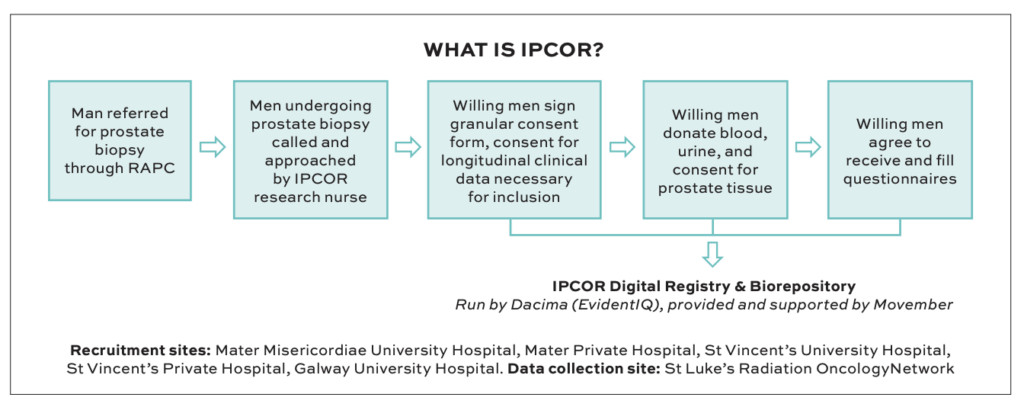
We were thrilled that Movember was able to support us with a second funding grant for the IPCOR 2 project (Figure 1). In this project, we were determined to become the data controllers, and own the data that we collected. This allowed us full control of the project from the outset.
Movember played a crucial role in providing a cloud database called Dacima, which is a clinical database on EU-based servers which allows us instant access to all of our collected data, and we can now create live dashboards containing data of every man entered into the database in real time. We have been able to optimise our clinical data collection. Our patient-reported outcomes have been broadened to reflect our research interests, and our patient group, the Lived Experienced Advisory Panel (LEAP), have advised the project in every aspect.
We are also thrilled that IPCOR 2 has created a bio-resource, collecting blood and urine specimens from a significant proportion of our patients. These samples are now stored in University College Dublin (UCD), and they represent a significant national research asset which will allow us to collaborate with multiple international researchers. The biological material is linked to the clinical data, and the patient-reported outcomes will make this a very attractive research tool at an international level. It is currently driving research in our own UCD.
The main difference between the two phases of the project is that IPCOR 1 operated under Irish legislation which allowed the cancer registry to collect cancer data for research purposes without consent. IPCOR 2 does not operate under this legislation, and, therefore, patient consent is required. Under GDPR and health regulations in Ireland, explicit consent for every aspect of the project was necessary, and this meant that the consent form was long and detailed. In addition, we sought consent from participants for future contact and for their involvement in future studies as well as access to their prostate tissue specimens.
In order to achieve high participation and to assist with the detailed consent process, research nurses are employed now in each of our hospital sites. As a result, IPCOR 2 as a project is more expensive to fund per site, due to the fact that two research staff are employed at each site. The current project operates across the Mater hospital campus in both the private and public hospitals, across the St Vincent’s campus in both the public and private hospitals, and in Galway University Hospital campus, the three busiest prostate cancer centres in Ireland.
“A total of six research staff are employed across the three busiest prostate cancer centres in Ireland”
A total of six research staff are employed across the three sites. They meet with every potential participant, phoning them in advance and sending necessary literature to read about the project before entering the consent process. The timing of consent was a subject of considerable debate. It was eventually decided to consent all men who attend for a prostate biopsy, and this meant that a certain proportion of men with a benign pathology would also be enrolled in the study, who have a normal biopsy. This was thought to benefit the project as it allowed us a control group for comparison purposes.
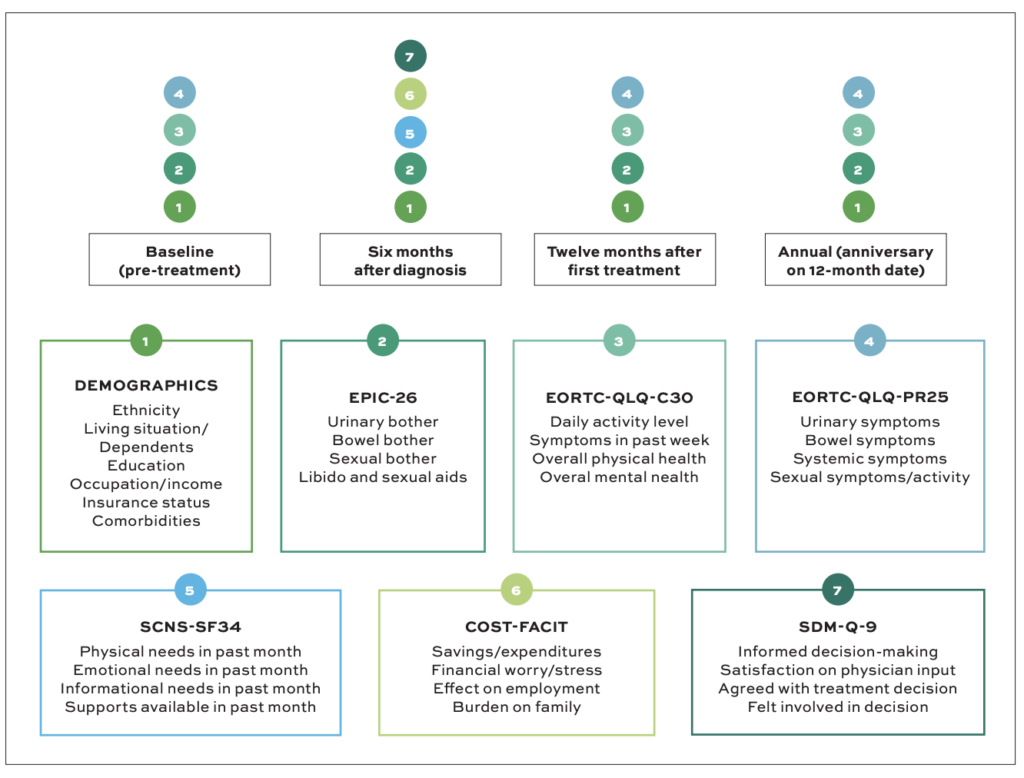
Men now attend for a prostate biopsy and are enrolled in the IPCOR 2 study. At this time, they complete the consent process and provide urine and blood specimens at baseline. They then receive an email and complete baseline patient-reported outcome measures (PROMs) questionnaires and are invited to complete PROMs again six months later, 12 months later, and every 12 months after that, in keeping with the global ICHOM (International Consortium for Health Outcomes Measurement) standard (Figure 2). This data is currently being collected on a prospective basis and we present the data back to the hospital teams on a six-monthly basis for discussion, reflection, and identifying areas for clinical improvement.
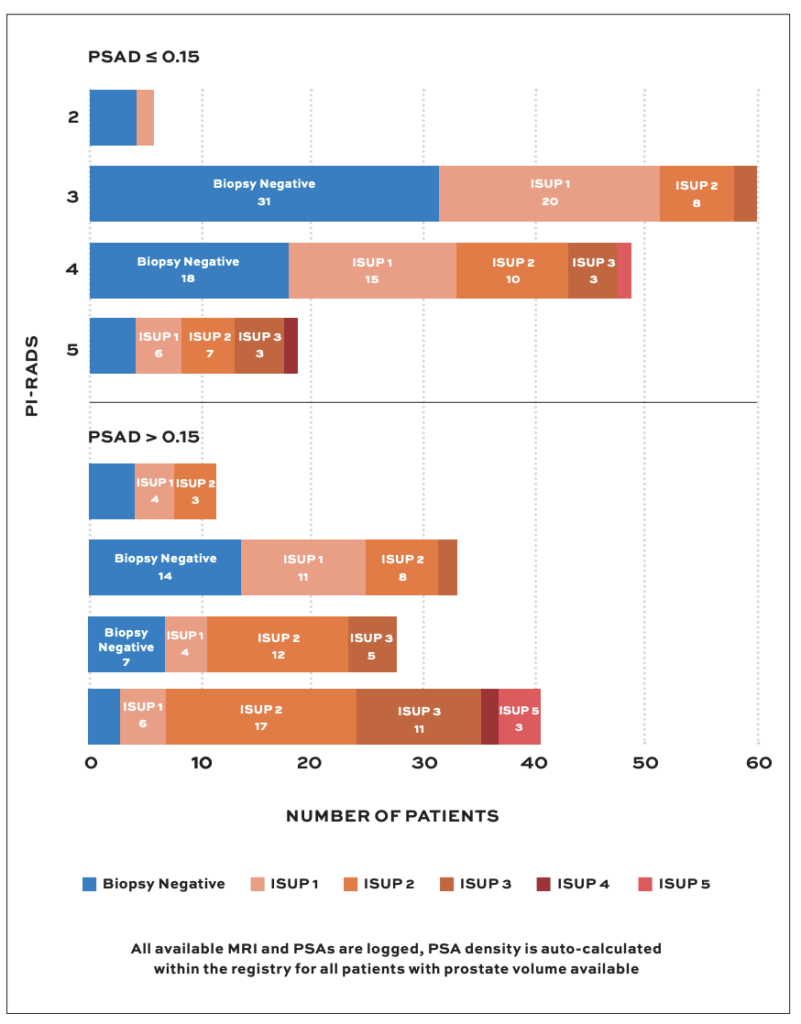
Figure 3 demonstrates a typical slide outlining PIRADS (prostate imaging-reporting and data system) scores from MRI, and the prostate biopsy results for each PIRADS score. It shows the value of prostate-specific antigen (PSA) density. We also provide each hospital management team with an annual report. Each of the contributing urologists also receives an annual report detailing the patients that they have diagnosed and treated throughout the year, the outcomes of those patients, and a comparison between their patients and the IPCOR group as a whole.
We are also in the process of establishing a robust mechanism whereby the patient’s reported outcomes are fed back to both the patient and the advanced nurse practitioner caring for that man, so that their clinical encounters are fully informed by the PROMs data, allowing for a comprehensive clinical encounter. We are also building the evidence base to support this initiative.
Driving clinical research in Ireland
Lastly, the IPCOR Registry has a major role to play in driving both translational and clinical research and cancer trials recruitment across Ireland. As the registry collects data in real time, we can identify patients suitable for specific clinical trials and invite patients to enrol in studies. In addition, the biobank that is being developed in UCD is already contributing to important translational research. By collecting blood, urine, and tissue specimens from men, and knowing their detailed clinical history, we are able to search for treatment targets and make our resource available to international researchers.
Through the generosity of both the Movember Foundation and Janssen Pharmaceuticals, we have been able to support the career development of two dedicated prostate cancer outcome fellows based in UCD, who have been committed to the development of clinical research. Our data also supports projects for public health students and we have presented widely at national and international conferences. The real strength in a clinical quality registry is prolonged longitudinal follow-up. Our main focus over the coming 18 months is to establish a sustainable financial footing so that the registry and all of the work done so far are built on, and the true potential of this initiative is realised.
References
- Gordon N, Dooley C, Murphy Á, et al. Irish Prostate Cancer Outcomes Research (IPCOR) registry: Cohort profile. BMJ Open. 2024;14(12):e090207. doi:10.1136/bmjopen-2024-090207.
- Gordon N, Patel AA, Farooq W, et al. Gleason regrading after prostatectomy-results from the Irish prostate cancer outcome research (IPCOR) situated in the international context. Int J Urol. 2026;33(5):e70469. doi:10.1111/iju.70469.
- Gordon N, Dooley C, Murphy Á, et al. Are we there yet? Closing the gap of prostate cancer presentation disparities in Ireland. Arch Public Health. 2024;82(1):210. doi:10.1186/s13690-024-01439-6.