Reference: October 2025 | Issue 10 | Vol 11 | Page 54
Eosinophilic oesophagitis (EoE) is a chronic, inflammatory, immune- or antigen-mediated oesophageal disease, resulting from recruitment and accumulation of eosinophils in oesophageal tissue. It can often present with symptoms synonymous with gastro-oesophageal reflux disease (GORD) and was previously felt to be a manifestation of GORD but is now known to be a distinct pathological entity. Most notably, clinical symptoms in EoE tend not to respond to typical acid-suppression treatments.
Its prevalence has previously been reported at 0.4 per cent in Western countries and it is more common in men.1,2 The prevalence is thought to be rising over recent years, perhaps due to its increased recognition as a distinct entity.
A New England Journal of Medicine review article states that the factors implicated in its pathogenesis include environmental factors such as birth by Caesarean section, antibiotic exposure early in life, genetics, and impaired barrier function.1
Symptoms
Core clinical manifestations include:
- GORD-like symptoms; heartburn
- Dysphagia
- Food impaction
- Retrosternal pain
- Upper abdominal pain.
As mentioned previously, EoE can often present with GORD-like symptoms such as heartburn and dysphagia, particularly in cases where the inflammation has resulted in oesophageal stricture.
Other manifestations can include food impaction, retrosternal pain, and upper abdominal pain.3 Of note, up to 54 per cent of patients undergoing endoscopy due to food impaction have EoE.3,4.
Boerhaave’s syndrome (oesophageal rupture due to forceful vomiting) is also a rare presentation of EoE.1
Diagnosis
The diagnosis is made following careful history-taking, examination, and, ultimately, upper gastrointestinal endoscopy and biopsy. It is important to rule out other causes such as GORD, Crohn’s disease of the oesophagus, and infection.
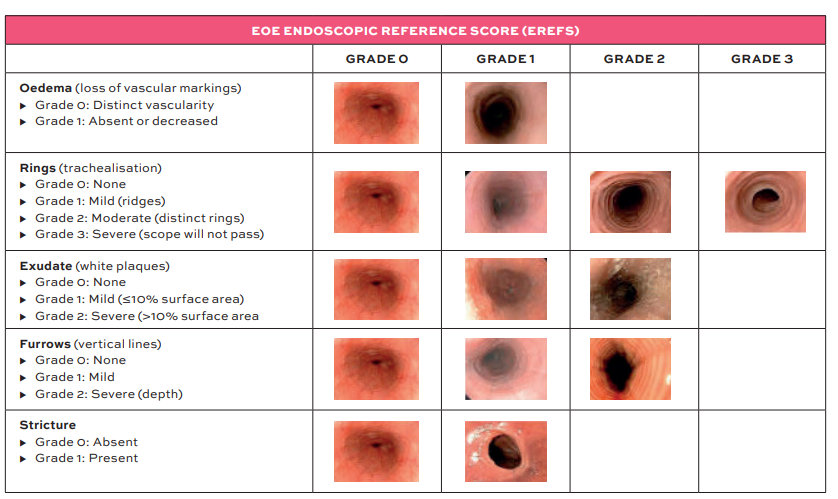
On basic laboratory blood testing, peripheral eosinophilia and/or an elevated IgE level can sometimes be seen. Endoscopically, features of EoE include trachealisation (fixed oesophageal rings), longitudinal furrows, plaque-like white exudates, strictures, and oedema.5
Figure 1 shows the various features of EoE endoscopically.5,6
Histologically, oesophageal biopsy typically shows eosinophil-predominant inflammation (>15 eosinophils per high-power field).
Imaging such as barium swallow studies can be a useful adjunct in the diagnosis of EoE, as it can identify strictures and trachealisation of the oesophagus.
Management
Avoidance of allergic triggers by dietary therapy is a recognised approach to the management of EoE. An empiric elimination diet avoiding cow’s milk is the most common initial approach. This is also known as the One-Food Elimination Diet (1FED).
Further options within the elimination diet would be to exclude cow’s milk, hen’s egg, soy, and wheat (4FED).7 These dietary approaches are often used in the paediatric population where the disease is well described.
Other dietary approaches include the Elemental diet – however, this requires medical supervision and may be reserved for more severe cases.
In addition to dietary measures, acid suppression with proton pump inhibitors (PPIs) or topical glucocorticoids can be used in the treatment of EoE. High-dose PPIs can be given for an eight-week course followed by a lower dose if there is symptomatic and/or endoscopic improvement.3
Topical glucocorticoids such as viscous budesonide can also be given and have been shown to be associated with a good histological response.8
This medication coats the oesophagus and has an immediate effect. It also largely acts locally and is advantageous over systemic steroids in terms of the side effect profile.
Other medical options include fluticasone which can be administered via a swallowed inhaler.
Complications
Major complications of EoE include stricture formation as a result of inflammation from the disease. Occasionally, if symptoms are severe and refractory to medical treatments, dilation may be required. This is undertaken with caution given the risk of mucosal tears and oesophageal perforation.
Future directions
The use of biologic therapies in EoE has been previously described in the literature. Dupilumab is a monoclonal antibody that can be used in refractory cases of EoE.9 It targets IL-4 and IL-13. Further research and evidence is required in the use of other biologic therapies for the treatment of EoE.
Conclusion
EoE, while often presenting similarly to GORD, is its own distinct clinical entity and must be treated as such. Management strategies range from conservative measures, such as dietary targets, to new biologic therapies for severe cases.
References
- Furuta GT, Katzka DA. Eosinophilic Esophagitis. N Engl J Med. 2015 Oct 22;373(17):1640-8. doi: 10.1056/NEJMra1502863.
- Dellon ES. Epidemiology of eosinophilic esophagitis. Gastroenterol Clin North Am. 2014 Jun;43(2):201-18. doi: 10.1016/j.gtc.2014.02.002.
- Bonis PAL. Clinical manifestations and diagnosis of eosinophilic oesophagitis (EoE). In: Gupta SK, editor. Clinical Manifestations. UpToDate: Wolters Kluwer; 2025.
- Straumann A, Bussmann C, Zuber M, et al. Eosinophilic esophagitis: Analysis of food impaction and perforation in 251 adolescent and adult patients. Clin Gastroenterol Hepatol. 2008 May;6(5):598-600. doi: 10.1016/j.cgh.2008.02.003.
- Hirano I, Moy N, Heckman MG, et al. Endoscopic assessment of the oesophageal features of eosinophilic oesophagitis: Validation of a novel classification and grading system. Gut. 2013 Apr;62(4):489-95. doi: 10.1136/gutjnl-2011-301817.
- Peterson K, Collins MH, Aceves SS, et al. Concepts and controversies in eosinophilic esophagitis: What’s coming down the pipe? Gastroenterology. 2024 Mar;166(3):382-395. doi: 10.1053/j.gastro.2023.10.035.
- Kliewer KL, Gonsalves N, Dellon ES, et al. One-food versus six-food elimination diet therapy for the treatment of eosinophilic oesophagitis: A multicentre, randomised, open-label trial. Lancet Gastroenterol Hepatol. 2023 May;8(5):408-421. doi: 10.1016/S2468-1253(23)00012-2.
- Franciosi JP, Gordon M, Sinopoulou V, et al. Medical treatment of eosinophilic esophagitis. Cochrane Database Syst Rev. 2023 Jul 20;7(7):CD004065. doi: 10.1002/14651858.CD004065.pub4.
- Schoepfer AM, Safroneeva E. Pharmacologic treatment of eosinophilic esophagitis: Efficacious, likely efficacious, and failed drugs. Inflamm Intest Dis. 2024 Jul 26;9(1):199-209. doi: 10.1159/000540275.