Reference: October 2026 | Issue 10 | Vol 12 | Page 64
‘Trauma’ has become a buzzword in the tertiary care landscape with the development of the National Trauma Strategy and associated centres; however, traumatic injuries and their associated infections interact with healthcare systems at all levels, from wound management with public health nursing, to early or indolent infection in primary care, to the extremes of patients transferred from the scene by helicopter to one of the two national trauma centres.
By their nature, trauma-related infections (TRI) pose a number of different challenges. At the more severe end, penetrating abdominal injuries, open fractures, and large soft tissue deficits demonstrate complexity in their surgical and antimicrobial management. The introduction of hardware such as ORIF into contaminated wounds, and a patient population with often lengthy hospital stays and repeated visits, with increasing risk of multi-drug resistant pathogens.
While ‘trauma’ can have a broad definition when it comes to injury, here we are relating to sudden onset injuries that require immediate medical attention, as defined by the National Trauma Strategy. While this cohort of patients’ initial interaction with the healthcare system is typically in the emergency department setting, they may present with infectious complications to their injuries in numerous ways.
Crucial to managing these patients are multidisciplinary team (MDT) meetings, involving stakeholder specialties such as trauma and general surgery, orthopaedics, plastics, and infectious diseases. The ability to make plans with consensus opinion, tie in early review, and have clear perspectives about what is feasible from a surgical or antimicrobial standpoint is essential for timely and efficient care.
Classification
TRIs are most easily stratified by injury location and depth.
SKIN AND SOFT TISSUE TRAUMA-RELATED INFECTIONS:
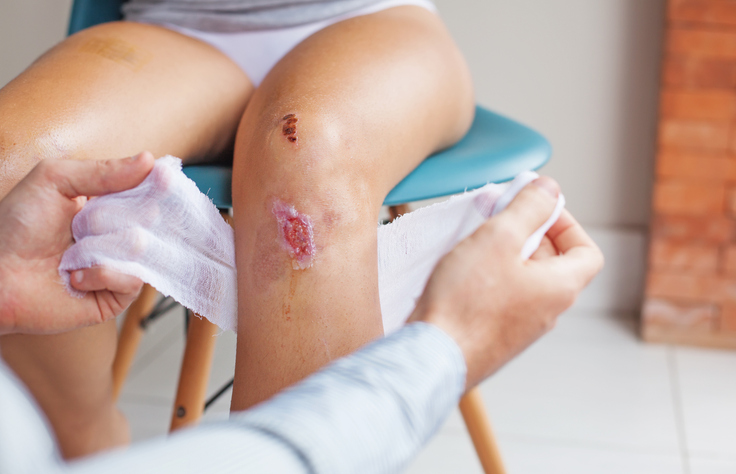
This ranges from cellulitis following skin penetrating injury to post-operative surgical site infection. The most common causative organisms are Staphylococcus aureus and Streptococcus spp, as is the case with non-traumatic skin and soft tissue trauma-related infections. However, there is a much higher incidence of polymicrobial and gram negative pathogens, particularly dependent on mechanism of injury and wound contamination. The history of the injury – in particular, the location, both geographical and anatomical – can offer clues to potential alternative causative organisms. In Ireland, farming injuries are common, and contaminated farm machinery increases the risk of gram negative and environmental organisms being introduced into a penetrating wound. The National Major Trauma audit reported that 3 per cent of major traumas presenting to hospital in 2022 were from the farm setting, approximately 100 per annum.
For the majority, treatment involves typical empiric cellulitis cover, but early review and consideration of escalation to broader cover is prudent. For grossly contaminated wounds, whether it be by environmental or inorganic material, or standing water exposure, empiric treatment covering gram positive, gram negative, and anaerobes is advised. Fresh versus salt water exposure should also be taken into consideration, for example, Aeromonas spp cover for freshwater or Vibrio spp for salt water contamination.
Obtaining samples for culture and susceptibility may seem advantageous, but the benefit of same depends on the wound and quality of sample attainable. Expressible purulent discharge for example, can greatly aid targeted therapy, but swabs of large soft tissue deficits with environmental exposure are more likely to reveal commensal growths and skin flora than true pathogens, and can misguide treatment.
Deeper seated infections may represent either progressive infection due to lack of source control, or deeper penetration of injury from index insult. Wounds over joints must be carefully considered and reviewed, for potential septic arthritis or bursitis. This is even more important in patients who may have previously undergone prosthetic joint replacement. Early involvement of the orthopaedic and plastic surgery in the trauma MDT approach is crucial.
Soft tissue or intramuscular abscesses require longer duration of antimicrobial therapy. Standard of care would be aspiration for both culture as well as reduction of bacterial burden. Four to six weeks of treatment is normal, with end of treatment imaging to ensure resolution of collections key to preventing infection relapse.
FRACTURE-RELATED INFECTION:
Risk of fracture-related infection (FRI) is related to the mechanism of injury and presentation of trauma. Closed fractures have a 1-2 per cent risk of infection, whilst with open fractures, that risk drastically increases to up to 30 per cent.
Open fractures with severe soft tissue deficits or degloving injuries or grossly contaminated from the trauma environment are often managed with external fixation, with the goal of internal fixation with soft tissue coverage within 72 hours if injury, alongside prophylactic empiric or targeted antibiotics. Open fractures without grossly evident infection, or closed fractures, can be harder to diagnose for fracture-related infection. Some may present with surgical site cellulitis or wound dehiscence, or a discharging sinus. However, infection may be more insidious, with boney non-union, disproportionate pain, or new joint effusion all being suggestive signs.
A fundamental concept in FRI is the presence of metalware, and the role of surgical management of same in order to achieve source control. Metalware provides a foci for bacterial growth and biofilm formation. Antibiotics alone will commonly fail to cure FRI. They may serve to bridge until union and metalware removal or for long-term suppression in some cases unfit for same, but without removal, the risk of osteomyelitis, relapsing infection, and progressive resistance is challenging.
Imperative to the management of FRI is the avoidance of empiric antimicrobials without initial tissue sampling, particularly in later presentation FRI. To do so is to jeopardise the yield of later samples for culture and susceptibility. Targeted antimicrobial therapy is of particular import to patients who may end up requiring long-term suppression of chronic infection, and empiric antibiotics up front can go so far as to risk loss of limb for some populations.
While there are some disparities between guidelines, general consensus is that open fractures should receive no more than 72 hours of empiric antimicrobials, or 24 hours post closure, whichever occurs first.
Patients with confirmed FRI typically receive up to six weeks of antibiotics from definitive management, with some nuances to individual cases. Increasingly, the use of local antimicrobial agents (such as antimicrobial impregnated cement) allows shortened durations of antimicrobial therapy following surgical debridement, and oral agents are preferred where possible.
INTRA-ABDOMINAL INFECTIONS/ABSCESSES:
To move away from limb and bone trauma-related infections, abdominal injuries present their own unique pathogen risks to consider. Abdominal trauma may be penetrative or blunt force, for example seatbelt contusional injuries may result in splenic rupture and requirement for splenectomy, with implications for the management of encapsulated bacteria and prophylaxis, or resulting in bowel perforation, with associated infections and collections.
While immediate empiric antifungal therapy for bowel perforation is not advised, fungal intra-abdominal collections – often in the presence of concurrent polymicrobial bacterial growth – are a common complication of traumatic bowel perforation.
Patients can frequently require repeated laparotomy and washout, and abdominal wall closure can be delayed due to the need for “relook” procedures in the immediate days post injury, or due to soft tissue deficit requiring secondary closure.
As with deep soft tissue abscesses, imaging of intrabdominal collections at the end of treatment is pertinent to ensure resolution before cessation of antimicrobials.
Infection due to gastrointestinal tract (GIT) trauma can be complex in terms of both causative organisms – with gram positive, gram negative, anaerobes, and fungi – particularly Candida spp – all common and requiring multiple agents that can be difficult to rationalise to a tolerable regimen for both patient and antimicrobial stewardship, but also by the nature of the injury. Trauma to the GIT often results in bowel resection or periods of bowel rest, which limits modality of agents to IV administration in the immediate period. This can also cause concern regarding absorption of oral agents in later stages of treatment, particularly if treatment failure or antimicrobial resistance develops.
As the National Trauma Strategy continues to develop, so must a comprehensive approach to associated infections, with early access to specialist care to those in the community who have concerns about infection after hospital discharge, or had intervention in a centre without a dedicated MDT. Clear pathways to trauma centres and infectious diseases services, with follow-up and clear communication to services for those “out of catchment” is crucial for continuity of care and reducing infectious complications and burden, with special consideration to access for those presenting in primary care.
Notably though, throughout the National Trauma Strategy steering group report, there is no mention of infection management, the role of infectious diseases and/or clinical microbiology in trauma, or pathways to follow-up, including post-repatriation. One model of care document does mention infection management, but in relation to infectious diseases outbreak in the context of the recent Covid-19 pandemic etc.
As the national trauma services develop, infrastructure should support the infectious consequences of traumatic injury, with appropriate pathways and funding, at all levels, from community and primary care to the two national centres.