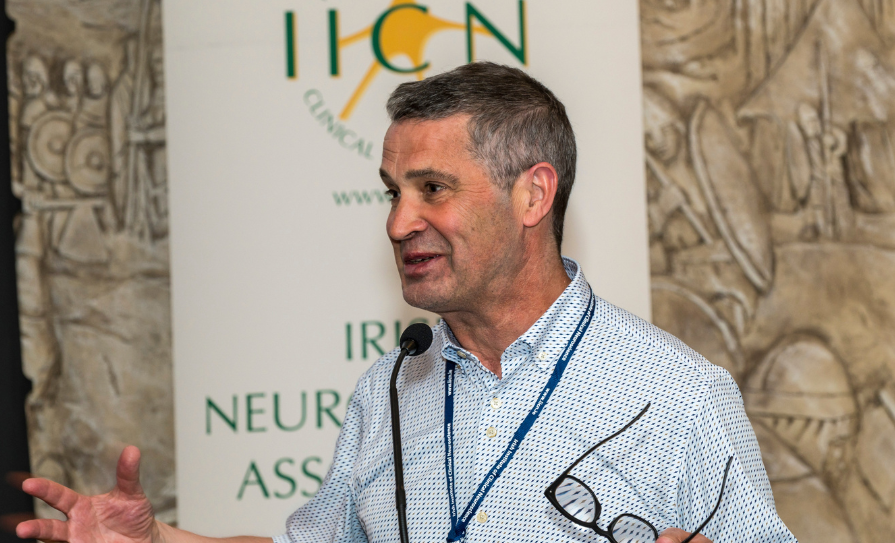
Prof Norman Delanty
At the Irish Neurological Association (INA) 2026 Annual Meeting, INA President Prof Norman Delanty expressed his pride at having led the Association to another successful conference.
Speaking to the Medical Independent (MI) at the event, Prof Delanty commented on the range of speakers, topics, and the impressive attendance: “I’m very happy with the meeting; an awful lot of preparation goes into it,” he said.
“It’s a fantastic turnout – Prof Boon was talking about the importance of brain health, for example, and you can see the expertise and the emerging expertise among neurologists and trainee neurologists. They have shown how we are not only treating specific diseases, but also looking at brain health as a national concern and maintaining brain wellness as an opportunity on a national level.
“Everything on a broader societal level has to have buy-in from Government and we are hoping that with the EU Presidency in Ireland over the next six months – there are a few meetings planned – that we can bring some of these very important policy issues to the Irish Government,” said Prof Delanty.
On the INA conference, he commented: “We have almost 200 delegates and the meeting has been very well supported by industry, medical media, and others,” he said.
“The standard of presentations has been incredible, and these have been from students still at medical school, obviously under supervision, right up to consultants, so I’m extremely happy.”
Prof Delanty was also asked what advice and encouragement he might offer to young doctors and graduates to encourage them to enter the field of neurology. “Neurology is a fascinating specialty, and neurological diseases are very interesting,” he told MI.
“Also, there are huge opportunities [for young doctors] in terms of understanding neurology and neurological disorders using new techniques, and more importantly, new treatments for what would have previously been considered untreatable conditions in the past.
“We are looking at new specific drugs, precision medicine, where you understand the molecular underpinnings of a disease, and you can change that with either a small-molecule drug or a gene therapy. In fact, we are now at a stage… with ongoing clinical trials to prove clinical benefit, where we may have the first gene therapy for a severe epilepsy associated with an intellectual disability, or what is termed a developmental and epileptic encephalopathy, and that’s on the horizon. That was unheard of when I started my role in Beaumont Hospital some years ago.”
There are also ongoing advances in genetic treatments, he explained, as well as neurogenetics and gene testing, which will lead to a greater understanding of specific treatment for individuals, opening up greater opportunities for precision treatments.
“Going back to a population level, as Prof Boon said, 43 per cent of global disease burden involves neurological or brain disorders, so there are huge opportunities to be part of the advances in care and in society for young medical students. And, of course, it is fundamentally fascinating – in the post-industrial era, what a country needs is brain capital.”
He concluded by saying: “We need to be able to practise medicine and practise neurology in a sustainable way, and the more specific and earlier diagnoses we make, and the better the treatment we can provide, the less wastage there is in terms of multiple scans, too much testing, and loss of quality-of-life for individuals with neurological disorders. We need to enable them to have a normal quality-of-life and to contribute to the workforce if that’s feasible, and it usually is. It’s not just about doing multiple scans for the sake of it – it’s about practising medicine wisely too.”












Leave a Reply
You must be logged in to post a comment.